

Edible and Lubricant Oil Packing Lines
Oil packaging requires accuracy, clean handling and reliable sealing. Even a small filling error can cause product loss, leakage, damaged labels and customer complaints. Manual filling also becomes difficult when production volume increases or different bottle sizes are used.
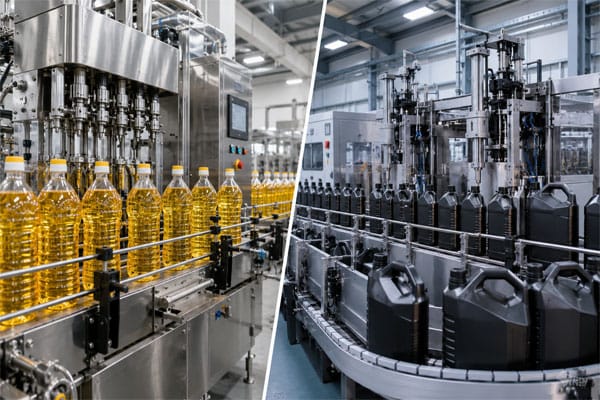
An Edible Oil Packing Line is designed for hygienic filling and packaging of cooking oils used in homes, restaurants and food-processing units. A Lubricant Oil Packing Line is developed for industrial oils that may have different viscosity, bottle sizes and handling requirements.
FillPack Industries provides oil-filling and packaging solutions that can include bottle feeding, filling, capping, sealing, labelling and final collection. The line can be configured according to the product, bottle, cap and required production capacity.
What Is an Edible Oil Packing Line?
An Edible Oil Packing Line is a complete packaging system used to fill and pack cooking oils into bottles, jars or containers. It helps manufacturers handle oils such as sunflower oil, mustard oil, soybean oil, groundnut oil, rice bran oil and coconut oil.
The line can include bottle feeding, accurate oil filling, cap placement, capping, induction sealing, labelling, batch coding and final bottle collection. It is designed to support hygienic handling, consistent filling quantity and leak-resistant packaging.
An Edible Oil Packing Line is commonly used by edible oil manufacturers, food-processing companies, oil refineries and private-label cooking oil brands.
What Is a Lubricant Oil Packing Line?
A Lubricant Oil Packing Line is an integrated system used to fill and package automotive and industrial oils into bottles, cans, jars, pails or other containers.
It can be used for products such as engine oil, hydraulic oil, gear oil, compressor oil, transformer oil, cutting oil and transmission fluid. Since lubricant oils may have different thickness levels, the filling system is selected according to the product viscosity and container size.
The line may include container feeding, lubricant filling, plug insertion, automatic capping, induction sealing, labelling, batch coding and finished-container collection.
Filling Technologies for Oil Packing Lines
Piston Filling System
A piston filler measures a fixed volume and pushes the oil into the bottle. It can be suitable for products with medium or higher viscosity.
Servo Filling System
A servo-controlled system provides adjustable filling movement and better control over volume and speed.
Flow-Meter Filling System
A flow meter measures the oil as it moves through the filling line. It can support flexible filling for different bottle volumes.
Net-Weight Filling System
This system fills the product according to the actual weight inside the container. It can be useful for larger packs or valuable products.
Gravity Filling System
Gravity filling uses product flow from a holding tank. It is generally more suitable for free-flowing liquids.
The correct filling method should be selected after checking the oil sample, bottle type and output requirement.
Edible Oil Packing Line vs Lubricant Oil Packing Linee
| Comparison Point | Edible Oil Packing Line | Lubricant Oil Packing Line |
|---|---|---|
| Main Product | Cooking and food-grade oils | Automotive and industrial oils |
| Hygiene Requirement | High food-processing hygiene | Industrial product-handling requirement |
| Common Containers | PET bottles, jars and pouches | HDPE bottles, cans, pails and jars |
| Filling System | Selected for edible-oil flow and accuracy | Selected according to lubricant viscosity |
| Product Contact Parts | Food-compatible construction required | Material compatibility with lubricant required |
| Typical Cap Types | Screw caps, ROPP caps and flip-top caps | Screw caps, plugs and industrial closures |
| Common Industries | Food and edible-oil processing | Automotive, engineering and industrial manufacturing |
| Labelling Requirement | Food branding and consumer information | Product grade and technical details |
| Packaging Sizes | Small to large retail packs | Retail and industrial container sizes |
Benefits of an Edible Oil Packing Line
Accurate Filling Quantity
The filling machine dispenses a controlled quantity of oil into every bottle. This helps reduce underfilling, overfilling and unnecessary product loss.
Hygienic Oil Handling
The line can be designed with suitable stainless-steel product-contact parts and easy-to-clean components. This supports clean handling of food-grade oils during packaging.
Higher Production Speed
Automatic bottle feeding, filling, capping and labelling allow more bottles to be packed in less time compared with manual operations.
Reduced Oil Wastage
Properly designed filling nozzles and controlled filling systems help reduce dripping, overflow and spillage around the machine.
Frequently Asked Questions
An Edible Oil Packing Line is an integrated system used to fill, cap, seal, label and pack cooking oils into bottles, jars or containers.
It can handle sunflower oil, mustard oil, soybean oil, groundnut oil, coconut oil, rice bran oil, palm oil and blended vegetable oils.
A Lubricant Oil Packing Line is a complete packaging system designed for filling and packing automotive and industrial oils into bottles, cans, jars or pails.
It can be configured for engine oil, gear oil, hydraulic oil, compressor oil, transformer oil, cutting oil and other industrial lubricants.
A complete line may include bottle feeding, oil filling, plug insertion, capping, induction sealing, labelling, batch coding and bottle collection machines.
Yes. Compatible bottle and container sizes can be handled through adjustable guides, machine settings and suitable change parts.
The filling system may use piston, servo, flow-meter, gravity or net-weight technology. The right system depends on oil viscosity, container size and required accuracy.
Accurate filling controls, properly designed nozzles and automatic bottle positioning help reduce overfilling, dripping, overflow and spillage.
Yes. Automatic capping, plug insertion, induction sealing, sticker labelling and coding machines can be connected to create a complete packaging line.
Selection should be based on the oil type, viscosity, bottle size, cap design, filling volume, required production speed, factory space and automation level.